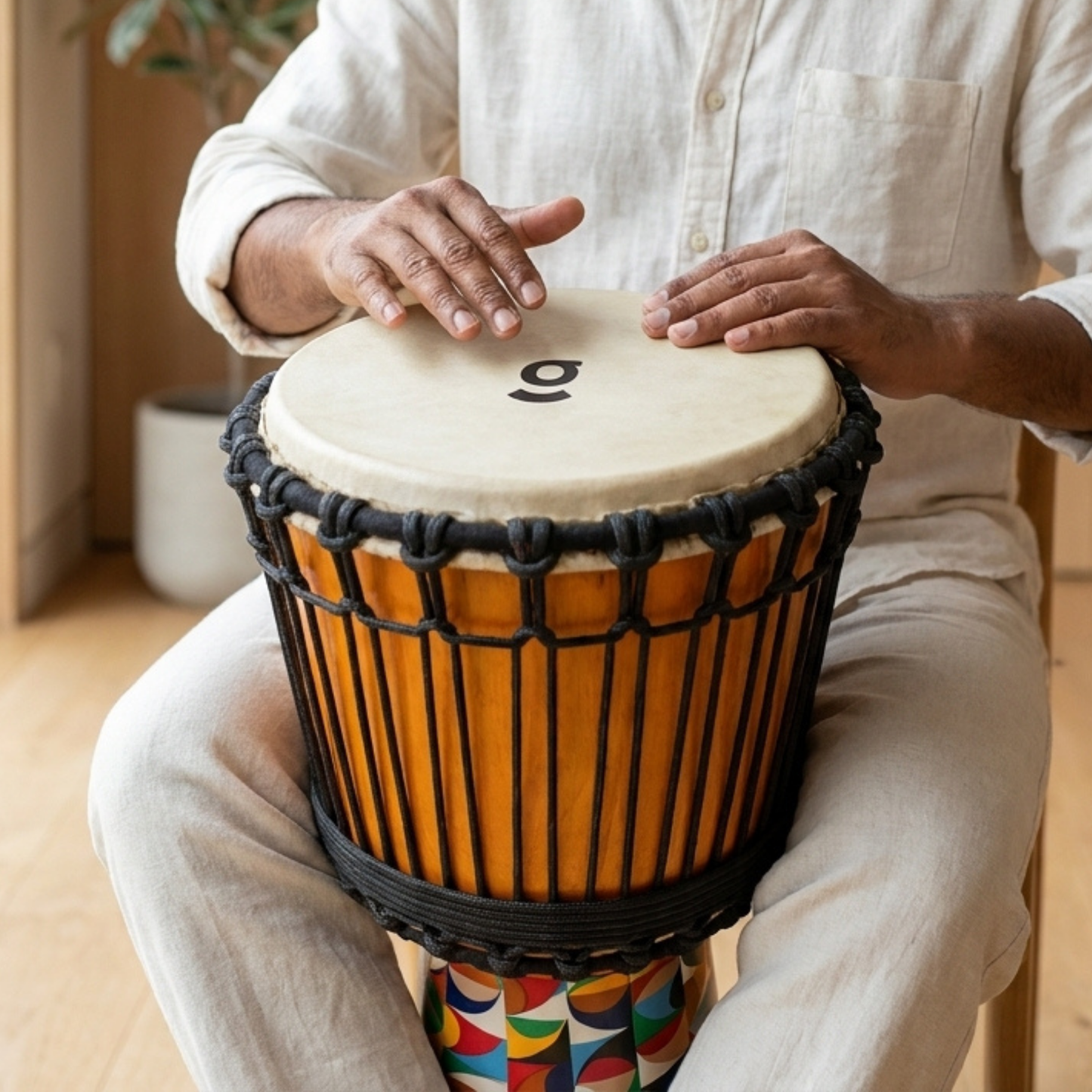
Gappu Djembe
Gappu Djembe
West African rhythm. Indian stage.
Couldn't load pickup availability
Traditional Rope Tuning
Natural Goat Skin Head
Versatile Playability
Rich Sound
Warranty Details
Warranty Details
Limited 6 month warranty
Contact support@gappu.co for further details
Specifications & Box Contents
What's in the Box ?
1 Unit Djembe
Dimensions (in):
Dimensions (cm):
Weight:

The Gappu Djembe brings the spirit of traditional West African percussion into modern Indian music spaces. Crafted with a mango wood body and natural goat skin head, it delivers warm resonance, expressive dynamics, and authentic hand percussion character.
Played with the hands naturally bouncing off the drumhead, each technique produces a distinct tone: deep bass (Boom), sharp accents (Ta), and warm open tones (Tu). Mastering these three sounds is the authentic foundation of djembe playing and unlocks endless rhythmic possibilities
Perfect For
- World music
- Rhythm circles
- Acoustic performances
- Percussion learning
- Ensemble play
Featuring traditional rope tuning and three distinct tonal zones, the Gappu Djembe offers versatility for solo practice, ensemble performance, and world music exploration. Whether used in acoustic circles, cultural performances, or rhythm workshops, it creates connection through rhythm.
Why You'll Love It
- Traditional rope tuning system for authentic tonal control
- Natural goat skin head with rich tonal response
- Three expressive tonal zones: bass, tone, slap
- Warm resonance from traditional mango wood construction
- Suitable for solo and ensemble percussion
FREQUENTLY ASKED QUESTIONS
What is the Gappu Djembe, and what kind of music is it used for?
The Gappu Djembe is a hand drum with West African origins, now played across world music, fusion, contemporary, and educational contexts globally. Built with a mango wood body and a natural goat skin head, it produces three distinct tonal voices: bass, tone, and slap - depending on where and how you strike the head with your hands. It is used in acoustic jam sessions, cultural and world music performances, rhythm circles, percussion workshops, Indian fusion recordings, yoga and wellness contexts, and school and college music programs.
What are the three tonal zones of a djembe, and how do I produce each sound?
Bass: Strike the centre of the head with the dominant hand, flat palm, fingers relaxed and
slightly closed. The resulting sound is deep. Tone: Strike the edge of the head (where it meets the rim) with fingers flat and relaxed, allowing them to bounce off immediately after contact. The tone is mid-range. Slap: Strike the edge of the head with fingers stiff and slightly curved, pulling them away sharply on contact. The slap produces a sharp sound.
Is the Gappu Djembe suitable for beginners with no percussion experience?
Yes. The djembe is one of the most approachable hand percussion instruments for beginners. There are no sticks, no pedals, no electronics, and no setup. The Gappu Djembe's natural goat skin head and mango wood body produce a warm, forgiving sound that is rewarding to play even at an early stage. Basic bass and tone strokes are learnable within the first session; the slap technique typically takes a few weeks of practice to develop clearly.
What does 'traditional rope tuning' mean, and how do I tune the Gappu Djembe?
Traditional rope tuning is the authentic West African method of tensioning a djembe head using a vertical rope system woven around the drum's body. Pitch is changed by adjusting tension of horizontal loops woven through the vertical ropes, pulling these horizontal 'diamonds' upward tightens the head and raises pitch; allowing them to loosen lowers pitch.
What is the difference between the 10-inch and 12-inch Gappu Djembe?
The 10-inch djembe has a smaller head diameter, producing a higher-pitched, brighter tonal character with slightly less low-end bass depth. The 12-inch djembe has a larger head diameter, producing more bass depth, warmer tones, and a fuller overall sound that carries better in ensemble and outdoor settings. If unsure, the 12-inch is generally the more versatile choice for adult players
Customer Reviews
I'm really enjoying the djembe from Gappu.
I love Gappu djembe
I recently bought djembe from gappu. I like it. my first experience with Gappu is great.
I absolutely love the djembe from gappu